
Teenager with Ehlers-Danlos syndrome hasn't eaten in a year
- Kelly Smith

- May 10, 2023
- 4 min read
Updated: Oct 14

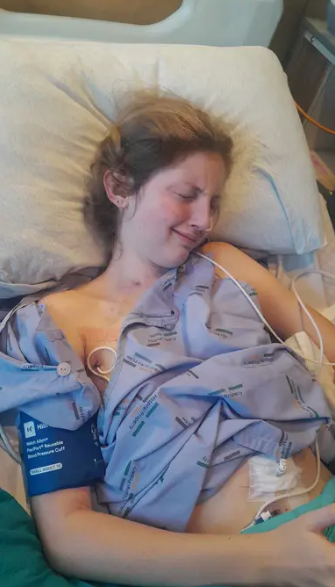
A 13-year-old girl hasn't been able to eat or drink for a year because of a rare health condition.
North Shore resident Emma Hartley has Ehlers-Danlos syndrome – a connective tissue disorder that causes the dislocation of joints – and as a result she has to be fed through a tube.
Surgery in Germany will allow her to eat normally again, but the Hartley family is looking at more than $180,000 in costs.
“It affects me in the way that I dislocate every couple of days, and this includes my knees, my fingers when I'm writing, my wrists,” Emma said.
"It hurts quite a lot... at my school we would do everything handwritten but because of how much I was dislocating with my fingers I had to transition to a computer, because I just couldn't write.
"When I dislocate at times my knees can turn really funny colours and I can end up on crutches for a couple of days.”
Ehlers-Danlos can cause other complications and Emma also suffers from abdominal vascular compressions which is why she has to be tube-fed.
"It got really bad last year in May... I completely lost my ability to eat or drink much more than an ice block,” she said.
"It's been really hard because food revolves around a lot of life, so I've had to miss out on a lot of things that normal teenagers do.
"I miss food a lot, I really miss Friday night takeaways."
Emma has faced bullying because of her health problems, and she was recently pulled out of school because it “all got too much”.
"Unfortunately, I lost most of my friends due to being tube-fed. I got judged quite badly when I had the tube in and when I was at school I got bullied. So it's been very socially isolating,” she said.
"There were kids who called me names and stuff, but it was more just people made assumptions, and they completely stopped talking to me. I was ignored, I was isolated and there were rumours that I had an eating disorder."
Emma said she has also faced barriers within the health system.
"Ehlers-Danlos isn't widely accepted in New Zealand. It's been quite hard getting proper management in a way,” Emma said.
“I really want people to know that yes, it might be rare, but we also need to stop misdiagnosing and mistreating the condition."
A surgery in Germany would help Emma to eat normally again, but with all expenses added up it will cost the Hartley family more than $180,000.
“This would hopefully take away a lot of the pain, a lot of the nausea, the vomiting. I’ll hopefully be able to get off the tube and back into eating,” Emma said.
"But the Ehlers-Danlos issue is not going to be resolved."
Her family has set up a Givealittle page to raise funds for the surgery and travel associated with it.
Ehlers-Danlos syndrome’s New Zealand spokesperson Kelly McQuinlan (she/they) said the state of care for people in Aotearoa with the condition is abysmal.
“The main hurdle is actually finding GPs that are willing to listen... and connect with colleagues to provide wraparound care,” she said.
"Often we are the ones that have to advocate for ourselves and our rights, and still receive push back from doing so.”
McQuinlan said the pathway to care and treatment is unique for each and every person with Ehlers-Danlos.
“Our medical professionals need to work with the consumer to help them achieve the life they want to live,” she said.
"Our rights as consumers have not been met, nor with meeting the rights of UNCRPD and Te Tiriti o Waitangi, and we find this happens time and time again when it comes to our rare communities."
Te Whatu Ora Health New Zealand spokesman Mike Shepherd said because not all Ehlers-Danlos syndrome patients are the same, treatment options will differ for each individual.
"Elhers-Danlos syndrome generally requires a specialist diagnosis and then multi-disciplinary support in the community that will often involve pain management, physiotherapy and splinting,” he said.
"We recognise that sometimes accessing all the multidisciplinary components of care in our current health system can be a challenge for patients."
He said Elhers-Danlos syndrome patients can access public healthcare services via primary healthcare professionals in their local area.
"We seek to deliver evidence-based assessment and treatment aligned with best evidence. We also recognise people’s rights to access alternative treatments,” he said.
"If patients are concerned about their access to care, we would encourage them to liaise with their primary care team or make further contact with the specialist team they have accessed previously."
Emma is documenting her journey on Facebook and wants to provide a voice for other young people suffering with the condition.
She said she is looking forward to eating again and living her life to the fullest.
"I want for the condition to have validation and I think we should be bringing dignity to the condition and dignity to the people who suffer with it,” she said.
"My goal is to be a doctor… to change the medical side of New Zealand so that kids with diseases like mine, they don't have to suffer as much I have.
"So that they can have better management of their conditions, and they're able to get better help than I have."


Comments